A participial phrase can make a sentence more vivid, concise, and polished, but it can also cause confusion when it is misplaced. If you have ever read a sentence that begins with “Running down the street” or “Covered in dust,” you have already seen this structure at work.
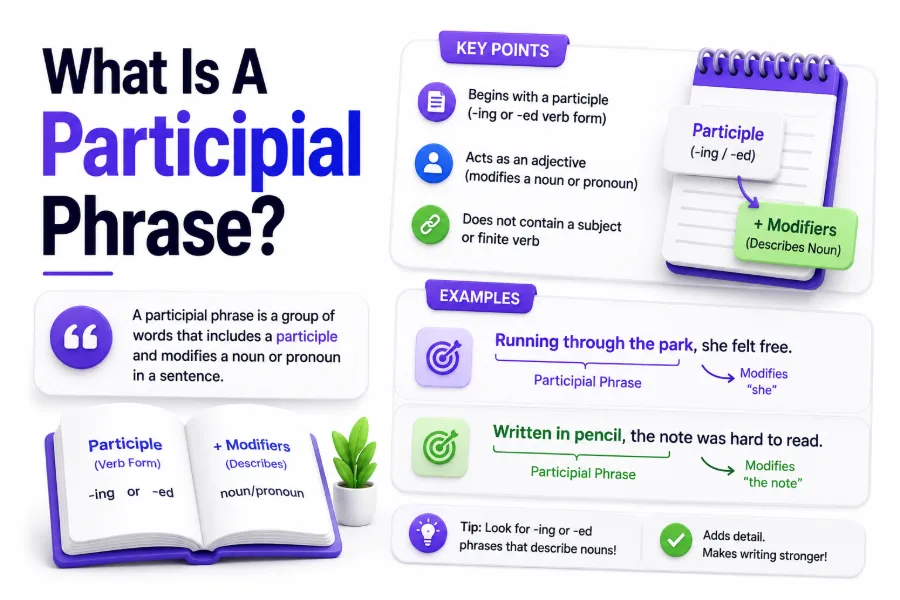
So, what is a participial phrase? It is a group of words built around a participle, usually ending in -ing or -ed, that describes a noun or pronoun. Writers use participial phrases to add detail without creating a separate sentence. They help show action, condition, timing, or description in a smooth way.
The tricky part is placement. A participial phrase must clearly connect to the word it modifies. When it does not, the sentence may sound awkward or even accidentally funny. This article explains how participial phrases work, how to identify them, and how to use them correctly in strong, natural sentences.
Participial Phrase Meaning
A participial phrase is a phrase that begins with a participle and includes any objects, modifiers, or related words attached to it. The entire phrase works like an adjective because it describes a noun or pronoun in the sentence.
For example, in “Smiling at the crowd, the singer stepped onto the stage,” the phrase “Smiling at the crowd” describes the singer. It tells readers what the singer was doing while stepping onto the stage, adding movement and detail.
How Participles Work in Sentences
A participle is a verb form used as an adjective. Present participles usually end in -ing, such as running, laughing, or shining. Past participles often end in -ed, -en, or -t, such as broken, written, or burnt.
Participles keep a sense of action, but they do not act as the main verb when used in a participial phrase. Instead, they describe a noun. This makes them useful for combining ideas while keeping a sentence clear and active.
Key Features of Participial Phrases
- They begin with a present or past participle.
- They function as adjectives.
- They describe a noun or pronoun.
- They may appear at the beginning, middle, or end of a sentence.
- They often add action, condition, or background detail.
- They must be placed close to the word they modify.
Present Participial Phrases
A present participial phrase begins with a present participle ending in -ing. It often shows an action happening at the same time as the main action in the sentence. These phrases can make writing feel more immediate and energetic.
For example, “Holding a cup of coffee, Maya opened the morning report.” The phrase “Holding a cup of coffee” describes Maya. It gives the reader a small visual detail while keeping the sentence compact and natural.
Past Participial Phrases
A past participial phrase begins with a past participle. It usually describes something that has already happened to the noun or shows the noun’s condition. These phrases are common in both formal and everyday writing.
Consider the sentence, “Damaged by the storm, the fence leaned toward the road.” The phrase “Damaged by the storm” describes the fence. It explains why the fence leaned without requiring a separate sentence.
Present and Past Participial Phrase Comparison
Type | Common Form | Example | What It Shows
Present participial phrase | -ing form | Walking through the park, she called her friend. | Ongoing action
Past participial phrase | -ed, -en, or irregular form | Broken by the fall, the vase lay on the floor. | Condition or completed action
Present participle | smiling, working, carrying | Carrying the files, he entered the office. | Action in progress
Past participle | written, closed, frozen | Written in pencil, the note was hard to read. | Result or state
Where Participial Phrases Appear
A participial phrase can appear at the beginning of a sentence. When it does, it is usually followed by a comma. This structure is useful when you want to introduce an action or description before naming the subject.
It can also appear in the middle or at the end of a sentence. In these positions, punctuation depends on whether the phrase is essential to the meaning. Nonessential phrases usually need commas, while essential phrases often do not.
Beginning of a Sentence
When a participial phrase opens a sentence, it should describe the subject that immediately follows. This keeps the meaning clear and prevents readers from connecting the phrase to the wrong noun.
For example, “Tired from the long meeting, Jordan left early.” The phrase clearly describes Jordan. A sentence like “Tired from the long meeting, the office felt quiet” would be incorrect because an office cannot feel tired.
Middle of a Sentence
A participial phrase in the middle of a sentence often adds extra information about a noun. If the information is not essential, commas should set it off from the rest of the sentence.
For example, “The teacher, reviewing the final essays, noticed a repeated mistake.” The phrase gives additional detail about the teacher. The sentence still makes sense without it, so commas are appropriate.
Placement Checklist
- Place the phrase close to the noun it describes.
- Use a comma after an opening participial phrase.
- Use commas around nonessential middle phrases.
- Avoid attaching the phrase to the wrong noun.
- Read the sentence aloud to test clarity.
- Check that the noun can logically perform or receive the action.
Participial Phrases and Commas
Comma use with participial phrases depends on position and importance. An introductory participial phrase almost always takes a comma because it comes before the main clause and prepares readers for the subject.
When the phrase appears after the noun, the comma depends on whether the phrase is extra information. If the phrase identifies which noun you mean, no comma may be needed. If it simply adds detail, use commas.
Essential Participial Phrases
An essential participial phrase gives information needed to identify the noun. Removing it would change the meaning or make the sentence less specific. These phrases usually do not need commas.
For example, “Students hoping to join the club should submit an application.” The phrase “hoping to join the club” tells which students the sentence refers to. Without it, the meaning becomes too broad.
Nonessential Participial Phrases
A nonessential participial phrase adds extra information but is not required to identify the noun. These phrases are usually separated with commas because they act like a side note.
For example, “The students, hoping to join the club, waited outside the office.” The phrase adds context, but the sentence still identifies the students without it. The commas show that the information is supplemental.
Common Participial Phrase Mistakes
The most common error is the dangling participial phrase. This happens when the phrase does not clearly describe the subject of the sentence. The result can be confusing because the sentence seems to assign an action to the wrong thing.
Another frequent mistake is placing the phrase too far from the noun it modifies. Even if the sentence is technically understandable, poor placement can slow the reader down and weaken the sentence’s flow.
Dangling Phrase Example | Corrected Version
Walking to the store, the rain began to fall. | Walking to the store, Lena felt the rain begin to fall.
Covered in sauce, Ben served the pasta. | Ben served the pasta covered in sauce.
Exhausted after practice, the couch felt comfortable. | Exhausted after practice, Marcus sank into the comfortable couch.
Reading the contract, several errors appeared. | Reading the contract, Priya noticed several errors.
How to Fix Dangling Participial Phrases
To fix a dangling participial phrase, identify who or what is doing the action in the phrase. Then make that noun the subject of the main clause. This simple adjustment usually solves the problem.
For example, “Driving through heavy traffic, the meeting started late” is unclear. The meeting was not driving. A better version is “Driving through heavy traffic, Carla arrived at the meeting late.”
Misplaced Participial Phrases
A misplaced participial phrase is grammatically close to the right idea but positioned poorly. It may seem to describe the wrong noun, especially when several nouns appear in the same sentence.
For example, “The manager spoke to the employee carrying a laptop.” Who carried the laptop, the manager or the employee? If the manager carried it, write, “Carrying a laptop, the manager spoke to the employee.”
Tips for Clear Participial Phrases
- Put the described noun immediately after an opening phrase.
- Keep long participial phrases away from crowded noun groups.
- Rewrite unclear sentences instead of trying to patch them.
- Use commas to guide the reader through nonessential detail.
- Avoid stacking several participial phrases in one sentence.
- Make sure the phrase sounds natural, not overly formal.
Participial Phrases Versus Gerund Phrases
Participial phrases and gerund phrases can look similar because both may begin with an -ing word. The difference lies in their function. A participial phrase acts like an adjective, while a gerund phrase acts like a noun.
In “Running through the hallway, the child slipped,” the phrase describes the child. In “Running through the hallway is unsafe,” the phrase acts as the subject of the sentence. That makes it a gerund phrase, not a participial phrase.
Participial Phrases Versus Infinitive Phrases
An infinitive phrase begins with “to” plus a verb, such as “to write a report” or “to finish the race.” Unlike participial phrases, infinitive phrases may function as nouns, adjectives, or adverbs depending on the sentence.
For example, “To improve her score, Elena practiced daily” uses an infinitive phrase to explain purpose. A participial version might be, “Practicing daily, Elena improved her score.” Both are valid, but they create different rhythm and emphasis.
Important Grammar Facts
- An -ing phrase is not always a participial phrase.
- A participial phrase always modifies a noun or pronoun.
- A gerund phrase functions as a noun.
- An infinitive phrase begins with “to” plus a verb.
- Participial phrases often create smoother sentence variety.
- Clear placement matters more than sentence length.
Why Writers Use Participial Phrases
Writers use participial phrases because they add detail without overloading a paragraph with short, choppy sentences. They help combine related ideas in a way that feels natural and efficient.
For example, “The dog barked. It stood near the gate. It wagged its tail” sounds repetitive. “Standing near the gate, the dog barked and wagged its tail” combines the ideas with better rhythm.
Adding Description Without Wordiness
Participial phrases are useful when a writer wants to show action and description at the same time. They can reduce repetition while giving readers a clearer picture of what is happening.
Instead of writing, “The painting was faded. It hung above the fireplace,” you can write, “Faded by years of sunlight, the painting hung above the fireplace.” The revised version is smoother and more descriptive.
Creating Sentence Variety
Good writing uses varied sentence patterns. Participial phrases help prevent every sentence from following the same subject-verb-object structure. This variety keeps readers engaged and improves the flow of a paragraph.
However, variety should never come at the cost of clarity. A participial phrase works best when it feels like a natural part of the sentence, not a decorative add-on.
Best Uses for Participial Phrases
- Adding visual detail to narrative writing.
- Combining closely related actions.
- Showing condition, cause, or timing.
- Improving sentence rhythm.
- Reducing repetitive sentence openings.
- Making descriptions more concise.
- Adding background detail in academic or professional writing.
Examples of Participial Phrases in Everyday Writing
Participial phrases appear in fiction, journalism, academic writing, business communication, and casual prose. They are not limited to literary sentences. Any writer can use them to make information more precise and readable.
For example, “Built in 1924, the library still serves the neighborhood” is clear and efficient. In business writing, “Reviewed by the finance team, the proposal moved to the next stage” gives useful context without extra clutter.
Examples With Present Participles
Present participial phrases often show action happening alongside the main action. They can create movement and help readers imagine the scene more clearly.
Examples include “Leaning against the counter, Nora checked her messages” and “Waiting for the train, the commuters watched the schedule board.” In both sentences, the phrase describes what the subject is doing during the main action.
Examples With Past Participles
Past participial phrases often describe a noun’s condition or the cause of that condition. They are especially useful when the noun has been affected by an earlier action.
Examples include “Shaken by the news, the team canceled the meeting” and “Printed on recycled paper, the brochure looked simple but professional.” These phrases add background information in a compact way.
Participial Phrase Examples by Use
Use | Example | Effect
Action | Carrying a stack of books, Liam entered the classroom. | Shows simultaneous movement
Condition | Covered in snow, the car was hard to recognize. | Describes appearance
Cause | Frustrated by the delay, the customer requested a refund. | Explains reaction
Timing | Arriving before sunrise, the crew prepared the equipment. | Shows when something happened
Background | Built by local volunteers, the shelter opened in June. | Adds useful context
How to Identify a Participial Phrase
Start by looking for a participle, especially an -ing word or a past participle form. Then check whether the phrase describes a noun or pronoun. If it does, you are probably looking at a participial phrase.
Next, find the noun being modified. Ask, “Who or what is doing this action, or who or what is being described by this condition?” If the answer is clear, the phrase is likely placed correctly.
Step One: Find the Participle
The participle is the core of the phrase. It may be a present participle like “speaking,” “turning,” or “waiting,” or a past participle like “closed,” “forgotten,” or “written.”
In “Written in careful handwriting, the letter felt personal,” the participle is “written.” The phrase “Written in careful handwriting” describes the letter, giving readers useful information about its appearance.
Step Two: Find the Modified Noun
After you locate the participle, identify the noun it describes. This step matters because participial phrases are only effective when the connection is clear and logical.
In “Glowing in the sunset, the windows looked golden,” the phrase describes the windows. The placement works because the noun comes immediately after the introductory phrase.
Identification Checklist
- Look for an -ing or past participle form.
- Check whether the phrase describes a noun.
- Find the noun or pronoun being modified.
- Test whether the noun logically fits the action or condition.
- Watch for commas that set off introductory or extra information.
- Rewrite the sentence if the modifier feels unclear.
How Participial Phrases Improve SEO Writing
Clear grammar supports better SEO because readable content keeps people engaged. Search engines do not reward awkward writing, and readers leave quickly when sentences are confusing or cluttered.
A well-placed participial phrase can make informational content easier to scan and more enjoyable to read. For related grammar topics, you might also review [Internal Link: grammar basics] to strengthen sentence-level writing.
Making Explanations More Efficient
SEO articles often need examples, definitions, and practical explanations. Participial phrases help writers present those details without making every sentence long or repetitive.
For example, “Designed for beginners, this worksheet explains sentence modifiers” is concise. It tells readers who the worksheet is for while keeping the sentence focused on the main subject.
Supporting Natural Keyword Use
Participial phrases can also help writers vary sentence structure around keywords. Instead of repeating the same pattern, writers can build sentences that sound natural while still covering the topic clearly.
For instance, an article about what is a participial phrase can include examples, definitions, and comparisons without repeating the exact wording in every paragraph. Natural language is better for both readers and search visibility.
Practical Writing Tips
- Use examples after definitions.
- Keep grammar explanations concrete.
- Vary sentence openings.
- Avoid adding phrases just to sound formal.
- Place modifiers beside the nouns they describe.
- Read revised sentences aloud.
- Link to related topics such as [Internal Link: sentence modifiers].
Participial Phrases in Academic Writing
Academic writing often uses participial phrases to condense information. They help writers connect ideas about cause, condition, and sequence without using too many separate clauses.
For example, “Supported by recent data, the argument became more persuasive” sounds polished and concise. The phrase adds context while allowing the main clause to remain direct and readable.
Participial Phrases in Creative Writing
Creative writers use participial phrases to add motion, mood, and sensory detail. A short phrase can show a character’s action or emotional state without slowing the scene.
For example, “Clutching the letter, Amara stood at the doorway” creates a visual moment. It tells readers what Amara is doing and suggests tension without explaining everything directly.
Participial Phrases in Business Writing
Business writing benefits from concise detail, and participial phrases can help. They allow reports, emails, and proposals to include context without sounding wordy or stiff.
For example, “Approved by the legal team, the contract is ready for signature” is clear and efficient. The phrase explains status while keeping the main message easy to find.
Strong Places to Use Participial Phrases
Use them when two actions are closely connected. If one action gives context for the other, a participial phrase can make the sentence smoother and more direct.
They also work well when describing appearance or condition. Phrases like “lined with trees,” “covered in notes,” or “marked by delays” can deliver useful information in very few words.
Weak Places to Use Participial Phrases
Avoid using participial phrases when the relationship between actions is unclear. If readers might wonder who performed the action, the sentence needs revision.
Also avoid piling several participial phrases into one sentence. Too many modifiers can make writing feel crowded. In many cases, a clear second sentence is better than a complicated single sentence.
Quick Revision Checklist
- Does the phrase clearly describe one noun?
- Is the noun close to the phrase?
- Is the phrase necessary or extra?
- Are commas used correctly?
- Would a separate sentence be clearer?
- Does the sentence sound natural when read aloud?
Conclusion
A strong participial phrase can make writing more precise, lively, and efficient. It gives readers extra information about a noun without forcing the writer to create another full sentence. The key is to make sure the phrase clearly connects to the word it describes.
When learning what is a participial phrase, focus on three things: the participle, the noun being modified, and the placement of the phrase. Present participial phrases often show ongoing action, while past participial phrases usually show condition or completed action. Both can improve sentence flow when used carefully.
Good grammar is not about making sentences complicated. It is about making meaning clear. Once you can identify participial phrases and avoid dangling or misplaced modifiers, you can use them confidently in blog posts, essays, reports, and everyday writing.
FAQ
What is a participial phrase in simple terms?
A participial phrase is a group of words that starts with a participle and describes a noun or pronoun. It works like an adjective and often adds action, condition, or background detail to a sentence.
How do I identify a participial phrase?
Look for a phrase beginning with an -ing word or past participle. Then check whether the phrase describes a noun. If it adds information about a person, place, thing, or idea, it is likely participial.
What is an example of a participial phrase?
In the sentence “Running toward the bus, Mia waved her hand,” the phrase “Running toward the bus” is participial. It describes Mia and tells what she was doing while she waved.
Can a participial phrase be at the end of a sentence?
Yes, a participial phrase can appear at the end. For example, “The children sat on the floor, listening to the story.” The ending phrase adds detail about what the children were doing.
What is a dangling participial phrase?
A dangling participial phrase does not clearly describe the correct noun. For example, “Walking home, the rain started” is incorrect because rain cannot walk. The sentence should name the person walking.
0 Comments