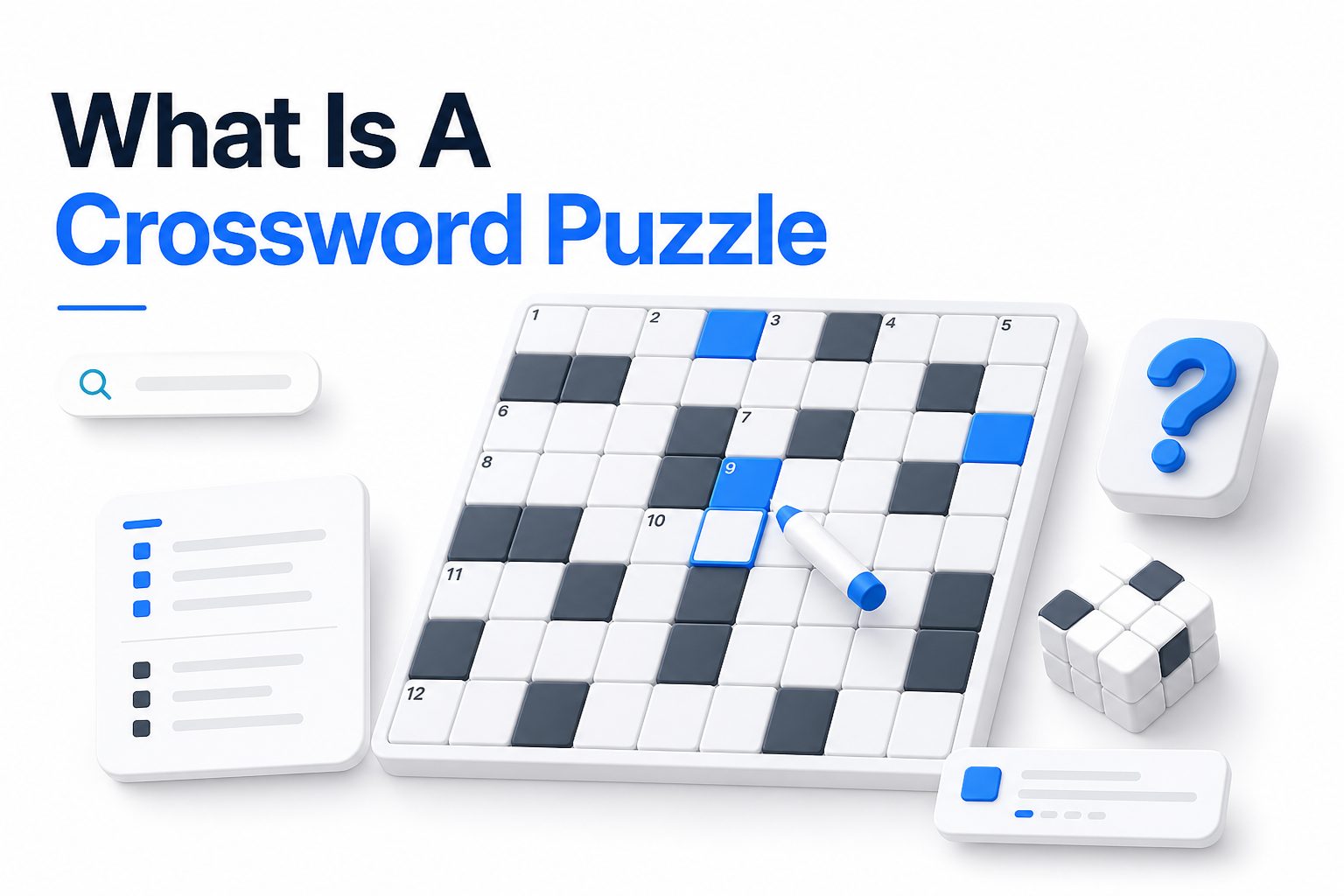
What is a cross word puzzle is a common question for anyone who has seen a grid of blank squares, numbered clues, and intersecting words but has never tried solving one. At its simplest, a crossword puzzle is a word game where answers are written into a grid, usually across and down, based on clues provided by the puzzle creator.
The appeal is easy to see once you begin. Each answer helps reveal letters for another answer, so the puzzle slowly opens up through logic, vocabulary, memory, and pattern recognition. Some clues are direct, while others use wordplay, abbreviations, or cultural references. That mix is what keeps crosswords interesting for beginners and experienced solvers alike.
Although many people associate crosswords with newspapers, they now appear in books, apps, classroom worksheets, websites, and competitive puzzle events. Whether you solve them for relaxation, brain training, or pure enjoyment, crossword puzzles offer a satisfying blend of challenge and discovery without needing special equipment or complicated rules.
What a Cross Word Puzzle Means
A cross word puzzle is a structured word game built around a grid. The solver fills empty squares with letters to form correct words or phrases. These answers are based on written clues, and they usually intersect so that one answer shares letters with another.
Most puzzles include two clue lists: Across and Down. Across answers run from left to right, while Down answers run from top to bottom. The shared letters create a built-in checking system, helping solvers confirm answers or spot mistakes as the grid fills.
How a Crossword Grid Works
The grid is the foundation of the puzzle. It contains white squares for letters and black squares that separate words. Each answer begins in a numbered square, and that number matches a clue in the Across or Down list.
When one answer crosses another, the shared letter must work for both words. This connection is what makes the puzzle feel less like a simple quiz and more like a layered logic game. A single correct letter can make several other clues easier.
Key Features of a Crossword Puzzle
- A grid made of blank and blocked squares
- Across and Down clue lists
- Numbered starting points for answers
- Intersecting words that share letters
- Clues ranging from simple definitions to clever wordplay
- A theme in many larger or newspaper-style puzzles
Common Crossword Puzzle Terms
Clue: The hint that points to an answer.
Entry: A word or phrase filled into the grid.
Grid: The pattern of squares that holds the answers.
Crossing: The point where an Across answer and a Down answer share a letter.
Theme: A repeated idea, pattern, or wordplay device used in selected answers.
Fill: The completed words in the grid, including theme and non-theme answers.
Why Crossword Puzzles Became So Popular
Crossword puzzles became popular because they are easy to start but difficult to master. A beginner can solve simple clues right away, while advanced puzzles offer layered wordplay, misdirection, and cultural references that reward experience.
They also fit neatly into daily routines. Many people solve a puzzle with coffee, during a commute, or before bed. The format offers a quiet mental challenge that feels productive without being stressful or overly demanding.
The Difference Between Crossword and Cross Word
The standard spelling today is “crossword,” written as one word. However, many people still search for “cross word puzzle” as separate words, especially when they are new to the topic or thinking about words crossing in a grid.
Both phrases usually refer to the same kind of puzzle. In formal writing, puzzle books, newspapers, and dictionaries, “crossword puzzle” is the accepted term. Still, the meaning remains clear when someone uses the two-word version.
Crossword Puzzle Versus Word Search
Feature | Crossword Puzzle | Word Search
Goal | Fill answers into a grid | Find hidden words in a letter grid
Clues | Usually provided | Often only a word list
Skill focus | Vocabulary, reasoning, wordplay | Visual scanning and pattern spotting
Grid style | Words cross and share letters | Words are already hidden
Difficulty | Can range from easy to expert | Usually simpler, though large grids can be hard
Types of Crossword Puzzles
The most familiar type is the standard crossword, often found in newspapers and puzzle books. It uses numbered clues and a square or rectangular grid. Answers cross each other, and many puzzles follow symmetry rules in the pattern of black squares.
Other types include cryptic crosswords, mini crosswords, themed crosswords, and educational crosswords. Each version keeps the basic grid-and-clue structure but changes the style, difficulty, or purpose to suit a different audience.
Standard Crossword Puzzles
Standard crosswords use straightforward clues, though some may include puns or mild wordplay. These puzzles often appear in daily newspapers and general puzzle collections, making them a good starting point for most solvers.
A standard clue might be as simple as “Large ocean” for “Pacific.” In harder puzzles, the same clue could be more indirect. The solver must learn how clue wording, tense, plural forms, and abbreviations shape the answer.
Cryptic Crossword Puzzles
Cryptic crosswords are more complex and popular in the United Kingdom and other regions. Each clue usually contains both a definition and a wordplay element, such as an anagram, hidden word, reversal, or charade-style construction.
For example, a clue may appear strange at first but secretly gives instructions for building the answer. Cryptic puzzles follow their own conventions, so they can feel difficult until the solver learns the language of the clues.
How Crossword Clues Are Written
Crossword clues are written to guide the solver toward an answer, but they do not always do so directly. Easy clues may give a simple definition, while harder clues may use a pun, abbreviation, double meaning, or cultural reference.
Good clues are fair, even when they are tricky. The answer should make sense once revealed. In well-made puzzles, clue wording is carefully chosen so the solver can look back and see why the answer fits.
Direct Clues
Direct clues work like short definitions. If the clue is “Frozen water,” the answer is likely “ice.” These clues are common in beginner puzzles, children’s puzzles, and educational worksheets because they focus on basic vocabulary.
Even direct clues can vary in difficulty. A clue for “tree” might be simple, but a clue for a rare plant, historical figure, or scientific term may require more knowledge. The structure stays simple, but the content can become harder.
Wordplay Clues
Wordplay clues rely on humor, double meanings, or unexpected interpretations. A clue like “Bank job” might refer to a role at a financial institution, not a crime. This kind of clue makes solvers pause and rethink assumptions.
Wordplay is one reason crossword puzzles remain popular with experienced solvers. The pleasure comes not only from knowing facts but from catching the trick. A clever clue can make a short answer feel surprisingly satisfying.
Helpful Clue Signals to Notice
- A plural clue usually needs a plural answer
- A past-tense clue often needs a past-tense answer
- Abbreviated clues may point to abbreviated answers
- A question-like clue often signals wordplay
- Fill-in-the-blank clues are usually easier entry points
- Quoted phrases may ask for a common response or expression
How to Solve a Crossword Puzzle
Start with the easiest clues first. Fill in answers you know immediately, especially short words and fill-in-the-blank clues. These early answers provide letters that help with harder clues crossing through the same parts of the grid.
Next, use crossing letters to narrow the possibilities. If you know a word starts with S and ends with E, your options become smaller. Crossword solving is often a process of building confidence letter by letter rather than knowing every answer instantly.
Use the Grid as a Solving Tool
The grid gives useful information beyond the clues. Answer length is fixed, so every guess must fit the available spaces. Crossings also confirm whether your answer works with neighboring entries.
If an answer seems right but creates impossible letters elsewhere, it may be wrong. Skilled solvers constantly test answers against the grid. This habit prevents one mistaken guess from spreading through the puzzle.
Return to Hard Clues Later
Difficult clues often become easier after other answers are filled in. A clue that seems impossible with no letters may become obvious when half the answer is already visible.
Leaving a clue blank is not failure. It is part of the solving method. Many experienced solvers move around the grid, collect easy answers, and return to stubborn sections once more letters are available.
Beginner Tips for Better Solving
1. Start with short answers because they often use common words.
2. Fill in obvious clues first to create helpful crossings.
3. Watch the tense, number, and part of speech in each clue.
4. Pencil in uncertain answers if solving on paper.
5. Take breaks when stuck; fresh eyes often help.
6. Read our crossword puzzle tips on the main website for more practice ideas.
Benefits of Solving Crossword Puzzles
Crossword puzzles support vocabulary growth by exposing solvers to new words, meanings, idioms, and references. Even when you miss an answer, seeing it later can help you remember it the next time it appears.
They also encourage flexible thinking. Solvers learn to move between literal meanings and playful meanings, between memory and logic, and between small details and the whole grid. That mental variety keeps the activity fresh.
Crosswords and Brain Health
Many people solve crosswords because they enjoy the mental workout. Puzzles engage memory, language, attention, and reasoning. While they are not a cure for cognitive decline, they can be a useful part of an active mental routine.
The benefit is strongest when the puzzle offers a real challenge without becoming discouraging. Solving the same easy format every day may be relaxing, but learning new clue styles and tougher grids keeps the mind more engaged.
Crosswords as Stress Relief
Crosswords can also be calming. They create a focused task with clear rules, small wins, and a satisfying finish. For many solvers, this makes the puzzle a break from screens, noise, and scattered attention.
The slow pace helps. You can solve one clue, pause, and return later. Unlike fast games, crossword puzzles do not require quick reflexes, making them suitable for quiet moments and steady concentration.
Key Benefits of Crossword Puzzles
- Builds vocabulary and word recall
- Encourages logical thinking
- Improves attention to detail
- Provides a relaxing daily habit
- Offers screen-free entertainment when solved on paper
- Supports learning in classrooms and study settings
- Gives a sense of progress through small wins
What Makes a Good Crossword Puzzle
A good crossword puzzle feels fair, balanced, and satisfying. The clues should challenge the solver without relying on random obscurity. Tough answers are acceptable when crossings help reveal them and the clue has a clear logic.
The grid should also be clean. Too many awkward abbreviations, partial phrases, or rarely used words can make a puzzle feel forced. Strong puzzles mix common language, interesting references, and smooth answer patterns.
The Role of a Theme
Many larger crosswords include a theme. Themed answers may share a joke, category, phrase pattern, hidden word, or common twist. A theme gives the puzzle personality and helps connect longer answers.
A good theme feels consistent. Once the solver understands the pattern, it can help unlock other theme answers. Poor themes feel random or too thin, leaving the puzzle without a strong central idea.
Fairness in Clue Writing
Fair clue writing means the answer can be reached through logic, knowledge, or crossings. A clue may be clever, but it should not feel misleading in a way that breaks the rules of language.
Editors often check clues for accuracy, tone, difficulty, and consistency. This is why professionally published puzzles usually feel polished. Every clue has to fit the answer, the audience, and the puzzle’s difficulty level.
Signs of a Well-Made Puzzle
Quality Area | What to Look For
Clues | Clear, accurate, and varied
Grid | Smooth fill with useful crossings
Theme | Consistent and memorable when included
Difficulty | Challenging but fair
Answers | Natural words and phrases
Solving feel | Steady progress with satisfying moments
Crossword Puzzle Difficulty Levels
Crossword difficulty depends on clue style, answer vocabulary, grid design, and cultural references. A small puzzle is not always easy, and a large puzzle is not always hard. The clue writing often matters more than size.
Beginner puzzles use direct clues and familiar answers. Advanced puzzles may use layered wordplay, vague definitions, uncommon terms, and misdirection. Newspaper puzzles often increase in difficulty throughout the week, with later puzzles requiring more experience.
Easy Crossword Puzzles
Easy crosswords are ideal for beginners, children, language learners, and casual solvers. They usually include clear definitions, common words, and fewer tricky references. The goal is steady progress rather than frustration.
These puzzles help solvers learn basic conventions. They show how clue grammar matches answers, how crossings work, and how answer length matters. Once those habits form, moving to harder puzzles becomes much easier.
Hard Crossword Puzzles
Hard crosswords expect solvers to know more conventions. Clues may be deliberately indirect, and answers may include slang, older terms, names, foreign words, or specialized knowledge. The challenge comes from both language and reference range.
Still, hard puzzles should be solvable with patience. Crossings are especially important at higher difficulty levels. Even when a clue is outside your knowledge, intersecting answers can reveal enough letters to make a reasonable guess.
Common Mistakes New Solvers Make
New solvers often treat every clue as a simple definition. That works for some puzzles, but many clues require flexible thinking. A word may have several meanings, and the clue may use the less obvious one.
Another common mistake is ignoring grammar. If the clue is plural, the answer is likely plural. If the clue uses an abbreviation, the answer may be abbreviated too. These small signals often matter as much as the clue’s meaning.
Forcing an Answer
Sometimes an answer feels right, but the crossings disagree. Beginners may keep it anyway, which can block the rest of the puzzle. A better approach is to stay flexible and mark uncertain answers lightly.
If several crossing clues become impossible, review the earlier entry. Crossword solving rewards confidence, but it also rewards revision. Changing one wrong letter can open an entire section.
Overlooking Simple Answers
Hard-looking clues sometimes have ordinary answers. Solvers may overthink them, especially in puzzles known for clever clues. The best habit is to test both the direct meaning and the playful meaning before deciding.
A clue does not have to be complicated just because the puzzle is challenging. Many grids mix easy, medium, and hard clues. Those easier answers give solvers a foothold and keep the puzzle moving.
Beginner Mistake Checklist
- Ignoring whether the clue is singular or plural
- Forgetting that tense usually matters
- Assuming every clue is literal
- Keeping a guess after crossings disprove it
- Skipping short answers that could unlock a section
- Missing abbreviations, initials, and common crossword terms
Crossword Puzzles in Education
Teachers often use crossword puzzles to reinforce vocabulary, spelling, reading comprehension, and subject knowledge. A science crossword might review terms like “cell,” “atom,” or “gravity,” while a history puzzle might focus on people, dates, and events.
The format works because it asks students to recall information actively. Instead of simply reading a definition, they must connect the clue to the correct word and spell it accurately in a limited space.
Language Learning With Crosswords
Crosswords can help language learners practice vocabulary in context. Clues encourage learners to think about meaning, word form, synonyms, and spelling. This makes the activity more active than memorizing a list.
Simple themed puzzles work especially well for beginners. Topics such as food, weather, family, travel, and classroom objects give learners a focused set of words. Crossings also provide helpful letter support when spelling is uncertain.
Classroom Puzzle Design
A good classroom crossword should match the learner’s level. If the clues are too easy, students finish without much thinking. If they are too hard, the puzzle becomes a guessing exercise instead of a learning tool.
Teachers can improve results by mixing direct clues with a few application-based clues. For example, instead of only defining a word, a clue might describe a situation where the word applies.
Practical Uses for Crosswords
- Vocabulary review before a quiz
- Warm-up activity at the start of class
- Spelling practice for younger learners
- Subject review in science, history, or literature
- Language learning practice for common word groups
- Group activity that encourages discussion
Crossword Puzzles in Newspapers and Online
Newspapers helped make crossword puzzles a daily habit. Many readers still associate them with print editions, especially the classic daily crossword. The puzzle page became a familiar place for quiet challenge and routine entertainment.
Online platforms have expanded crossword access. Solvers can now play mini puzzles, themed puzzles, archives, timed challenges, and interactive grids. Digital tools also allow hints, error checking, and progress saving, which can make solving less intimidating.
Print Crosswords
Print crosswords offer a traditional solving experience. Many people enjoy writing answers by hand, making notes, and stepping away without notifications. Paper also makes the puzzle feel more personal and relaxed.
The drawback is that corrections can be messy. If you are unsure about an answer, writing in pencil helps. Puzzle books and newspapers remain excellent choices for people who want a screen-free habit.
Digital Crosswords
Digital crosswords are convenient and flexible. They are easy to access on a phone, tablet, or computer. Many apps offer daily puzzles, difficulty filters, hints, timers, and archives for extra practice.
Some solvers prefer digital grids because mistakes are easier to fix. Others enjoy the speed of typing. The best format depends on your routine, comfort, and whether you want a relaxed or competitive experience.
How to Build Your Crossword Skills
The best way to improve is to solve regularly. Start with easier puzzles and gradually move up. Repeated exposure teaches common clue patterns, frequent answers, abbreviations, and the rhythm of crossword language.
Reviewing missed answers is just as important. When you finish or reveal a puzzle, look at the clues you could not solve. Ask why the answer fits. That reflection builds skill faster than simply moving to the next grid.
Keep a Personal Word List
A personal word list can help newer solvers remember common crossword entries. Words like “aria,” “ore,” “emu,” and “era” appear often because their letters fit grids well. Learning them reduces future friction.
You can also list clue types that tricked you. Over time, patterns become familiar. A clue that once felt unfair may later seem clever because you recognize the convention behind it.
Practice With Different Sources
Different puzzle creators have different styles. Solving from only one source can limit your growth. Try newspaper puzzles, books, apps, and themed puzzles to build a wider solving instinct.
Variety also keeps the habit enjoyable. One day you might solve a quick mini puzzle; another day you might spend longer on a weekend grid. Both experiences sharpen different skills.
Skill-Building Tips
1. Solve a little every day instead of cramming.
2. Read explanations for clues you missed.
3. Try puzzles from several publishers.
4. Learn common abbreviations and repeated entries.
5. Use crossings before asking for hints.
6. Visit our word puzzle strategies page on the main website for more solving help.
Conclusion
A crossword puzzle is more than a grid of blank squares. It is a word-based challenge that combines vocabulary, logic, memory, and playful thinking. Once you know how the grid works, how clues point toward answers, and how crossing letters support your guesses, the format becomes much easier to enjoy.
For beginners, the best approach is simple: start with easy puzzles, fill in what you know, use crossings carefully, and stay flexible when an answer does not fit. Over time, clue patterns become familiar, common entries return, and harder puzzles feel less intimidating.
Whether you solve on paper, in a newspaper, through an app, or in a classroom setting, crosswords remain one of the most rewarding word games ever created. If someone asks what is a cross word puzzle, the answer is simple: it is a clever, structured game where words cross, clues guide you, and every correct letter brings the whole grid closer to completion.
FAQ
What is the main goal of a crossword puzzle?
The main goal is to fill the grid with correct words or phrases based on the clues. Each answer must fit the available spaces and work with crossing answers that share letters.
Are crossword puzzles good for beginners?
Yes, beginners can start with easy or mini crosswords. These puzzles use simpler clues and common vocabulary, making them a practical way to learn solving habits without becoming overwhelmed.
Why do crossword clues sometimes feel tricky?
Clues can use double meanings, abbreviations, puns, or indirect wording. This is part of the challenge. The answer should still make sense once you understand how the clue is written.
What is the difference between Across and Down clues?
Across clues lead to answers written from left to right in the grid. Down clues lead to answers written from top to bottom. Both types often intersect and share letters.
How can I get better at solving crosswords?
Practice regularly, begin with easier puzzles, study missed clues, and pay attention to tense, plural forms, and abbreviations. Over time, repeated clue patterns and common answers become easier to recognize.
0 Comments